
GST Implication on Transfer of Business as a Going Concern
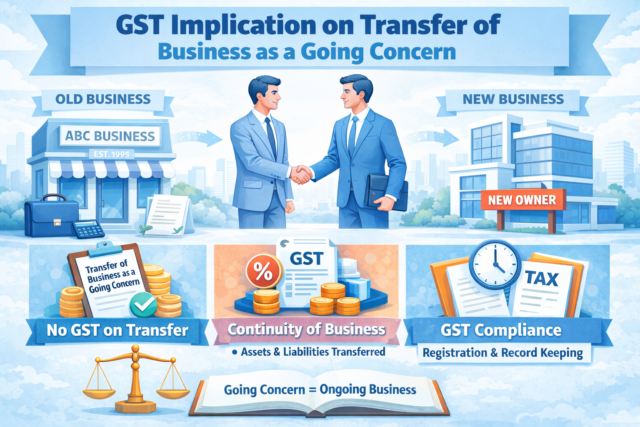 Under GST law, the transfer of business as a going concern is considered a supply of services and is liable to GST. However, vide Notification No. 12/2017 – Central Tax (Rate), an exemption is provided for “services by way of transfer of a going concern, as a whole or an independent part thereof.”
To determine GST applicability, it is essential to establish whether the transaction qualifies as a transfer of business as a going concern, or whether it is merely a sale of assets/liabilities, since only the former enjoys exemption.
Although GST law does not explicitly define “going concern,” reference can be drawn from the Education Guide issued under the erstwhile Service Tax regime by CBIC. Under Service Tax, it was clarified that a business would be considered transferred as a going concern if it was transferred to the transferee along with all its assets and liabilities.
Similarly, various judicial rulings under the erstwhile regime has clarified that transfer of business as a going concern means the sale of a business as an operating entity, capable of being carried on by the purchaser as an independent unit.
Basis above provisions and interpretation of law, it is clear that the legislature’s intent is to exempt transactions where the whole business remains a functional unit after transfer, enabling the transferee to continue operations without interruption. Conversely, mere sale of assets, machinery, employees, or liabilities would not qualify as a transfer of a going concern and would be liable to GST.
Procedural Compliances Applicable to Transferor and Transferee
- The transferor must file Form ITC‑02 for transfer of unutilized ITC, and the transferee must accept the same on the GST portal.
- If the transferor and transferee are not registered in the same state, ITC transfer is not permitted.
- After transferring ITC, the transferor must file an application for cancellation of GST registration.
- Within 90 days, the transferor must file the final return in Form GSTR‑10.
Disclaimer
This article is intended solely for general informational purposes. It does not constitute a legal opinion, tax advice, or a formal interpretation of law. The applicability of GST provisions may vary depending on specific facts and circumstances. Readers are advised to seek professional consultation before taking any action based on the information provided herein.
Planning a business transfer or restructuring? See our indirect taxation services and regulatory and corporate advisory services.