
GST on Liquidated Damages: Compensation vs. Taxable Supply
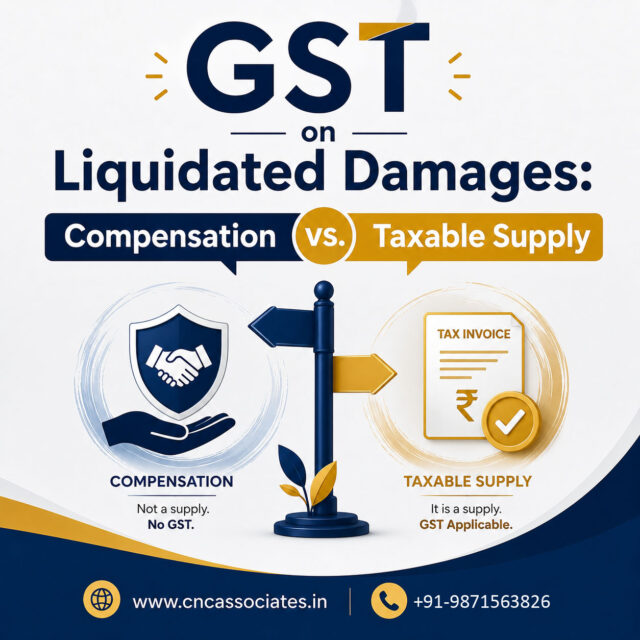 Under GST law, supply of any goods or services is liable to levy of tax unless there is any specific exemption. In this regard, section 7 of CGST Act, 2017 defines “supply” as a taxable event and every supply is liable to levy of GST unless the same is exempt from levy of tax.
However, Schedule II, Para 5(e) of the CGST Act, 2017, provides that any activity for “Agreeing to the obligation to refrain from an act, or to tolerate an act or a situation, or to do an act” shall be treated as a supply of services under GST law and liable to GST.
In commercial contracts, a Liquidated Damages (LD) clause is commonly included to compensate one party when the other fails to meet agreed obligations. With the advent of GST, businesses have debated whether such payments fall under the ambit of “supply.”
Now the question arises whether consideration flowing towards liquidated damages are in the nature of taxable supply or compensation for breach of obligation by one party & loss incurred by the party.
In order to comment on taxability, it is pertinent to understand the term Liquidated damages. Per-se, there is no specific definition of liquidated damages under GST law. However, they are generally understood as compensation for loss, unless they involve an agreement to tolerate or refrain from an act for consideration.
In the absence of clarity on taxability of LD, CBIC issued Circular No. 178/10/2022-GST, which clarified that any penalty/compensation received for any loss or damage caused by breach or non-performance of contract is not by way of consideration for any other independent activity, it is just an event in the course of performance of that contract and hence not taxable under GST regime including erstwhile service Tax regime.
Relevant extracts/paras from the circular are reproduced hereunder:
7.1.1 It is common for the parties entering into a contract, to specify in the contract itself, the compensation that would be payable in the event of the breach of the contract. Such compensation specified in a written contract for breach of non-performance of the contract or parties of the contract is referred to as liquidated damages. Black’s Law Dictionary defines ‘Liquidated Damages’ as cash compensation agreed to by a signed, written contract for breach of contract, payable to the aggrieved party.
7.1.2 Section 74 of the Contract Act, 1972 provides that when a contract is broken, if a sum has been named or a penalty stipulated in the contract as the amount or penalty to be paid in case of breach, the aggrieved party shall be entitled to receive reasonable compensation not exceeding the amount so named or the penalty so stipulated.
7.1.3 It is argued that performance is the essence of a contract. Liquidated damages cannot be said to be a consideration received for tolerating the breach or non-performance of contract. They are rather payments for not tolerating the breach of contract. Payment of liquidated damages is stipulated in a contract to ensure performance and to deter non-performance, unsatisfactory performance or delayed performance. Liquidated damages are a measure of loss and damage that the parties agree would arise due to breach of contract. They do not act as a remedy for the breach of contract. They do not restitute the aggrieved person. It is further argued that a contract is entered into for execution and not for its breach. The liquidated damages or penalty are not the desired outcome of the contract. By accepting the liquidated damages, the party aggrieved by breach of contract cannot be said to have permitted or tolerated the deviation or non-fulfilment of the promise by the other party.
7.1.4 In this background a reasonable view that can be taken with regard to taxability of liquidated damages is that where the amount paid as ‘liquidated damages’ is an amount paid only to compensate for injury, loss or damage suffered by the aggrieved party due to breach of the contract and there is no agreement, express or implied, by the aggrieved party receiving the liquidated damages, to refrain from or tolerate an act or to do anything for the party paying the liquidated damages, in such cases liquidated damages are mere a flow of money from the party who causes breach of the contract to the party who suffers loss or damage due to such breach. Such payments do not constitute consideration for a supply and are not taxable.
Thus, basis above it has been clarified that “liquidated damages are mere a flow of money from the party who causes breach of the contract to the party who suffers loss or damage due to such breach and such payments do not constitute consideration for a supply & not taxable.
Further, in para 7.1.5 and 7.1.6 of the said circular, CBIC has explained with examples whether consideration is in the nature of compensation for the loss suffered or consideration for a supply.
As per Para 7.1.5, key factor for consideration whether the impugned payments constitute consideration for another independent contract envisaging tolerating an act or situation or refraining from doing any act or situation or simply doing an act. If the answer is yes, then it constitutes a ‘supply’ within the meaning of the Act, otherwise it is not a “supply”.
However, as per Para 7.1.6, if a payment constitutes a consideration for a supply, then it is taxable irrespective of by what name it is called, it must be remembered that a “consideration” cannot be considered de hors an agreement/contract between two persons wherein one person does something for another and that other pays the first in return.
Disclaimer: This blog/article is intended solely for general informational purposes. It does not constitute a legal opinion, tax advice, or a formal interpretation of law. The applicability of GST provisions may vary depending on specific facts and circumstances. Readers are advised to seek professional consultation before taking any action based on the information provided herein.